
Lampasas County Court Record Requests
Begin with the court, not just a name. The Lampasas County District Clerk keeps the 27th District Court's files. Those cover felony, civil, family, and related district matters. The Lampasas County Clerk handles the constitutional County Court along with probate clerk duties. Each justice court and municipal court holds its own lower-court file. A cause number helps, and so do a court name, filing date, and document title. Together they keep a request from landing on the wrong desk.
Several access paths exist. Dated District Court and County Court PDF dockets are free online. re:SearchTX adds coverage when the court and record participate. For a file copy, contact the responsible clerk. Phone, email, fax, mail, or the counter all work. The county also accepts general open-records correspondence. That route does not override the rules governing court files.
- Identify the court, cause number, case style, and exact paper sought.
- Check the county docket page or re:SearchTX before ordering a copy.
- Ask the proper clerk whether inspection, email delivery, mail, or counter pickup is available.
- State whether the copy must be plain or certified and request a current fee quote.
- Provide payment and a return envelope if the clerk requires one.
Lampasas County Court Record Custody
No single search covers every Lampasas County court record. Custody follows court jurisdiction. District Clerk custody covers district cases. County Clerk custody covers County Court and probate work. JP clerks keep precinct matters, and city clerks keep municipal citations and ordinance cases. For lower-court requests, the issuing court is the key fact.
One warning matters here. The County Clerk states that its staff does not conduct searches for the public. Its eDoc and QuickLink services cover digitized land and official records. They do not offer a combined court-case search. So bring a precise record reference to the counter. If only a name is known, start with the county's dated docket lists or re:SearchTX. Then confirm custody with the clerk. The official County Clerk page shows the counter guidance used for Lampasas County record routing.
That is why a known file or document reference beats an open-ended public search request every time.
Kinds of Court Records
A court file runs broader than its docket sheet. Lampasas County court case records can include the initiating pleading, answers, motions, notices, signed orders, judgments, and disposition papers. Criminal district files may add indictments, bond-related entries, settings, and disposition records. Civil and family files often hold petitions, answers, motions, settings, and orders, subject to access limits. Probate papers sit with County Court records. JP and city matters stay with their own clerks.
- Docket sheets and dated setting lists
- Pleadings, motions, notices, and responses
- Signed orders, judgments, and disposition papers
- Public exhibits and attachments accepted into the file
- Probate, justice-court, or municipal papers held by the proper clerk
A transcript is a different product from a clerk's copy of filed papers. Ask whether a court reporter or another custodian holds it. Similarly, an eFileTexas filing receipt only proves submission activity. It is not the public Lampasas County court record. And it is not the court's accepted docket entry.
Older Lampasas County Case Files
Historic research takes a different route. The Texas State Library's Lampasas County inventory identifies district civil case papers on microfilm for 1873 through 1930. It also lists civil minutes for 1877 through 1914. Some criminal-minute volumes were never filmed. So a missing online image does not prove that no Lampasas County court record survives.
When you contact the clerk or archive, give them a court, an approximate year, a party name, and a record series. Older books may be indexed by volume and page rather than a modern cause number. The historic QuickLink book selector can help with county official records. But treat it as a county tool, not a district case docket. Keeping that distinction straight saves time. It also keeps a genealogy or historical inquiry in the right collection.
Court Records: What They Contain
The official Lampasas County sample dockets show how an event list points into a fuller file. Criminal lists include court, judge, case number, indictment date, setting, time, offense, counsel, bond, disposition, and narrative fields. Civil lists use a cause number, case style, category, time, duration, setting, counsel or pro se status, and print date. "Pro se" simply means a party appears without a lawyer.
| Cause or Case Number | The court’s file identifier; use the exact value shown on a notice or docket. |
|---|---|
| Pleadings | Petitions, complaints, answers, motions, and other papers filed by parties. |
| Orders and Judgments | Signed rulings that state what the court decided or directed. |
| Docket Sheet | A dated event and setting history, not necessarily every document image. |
| Exhibits | Filed or admitted material, when public and retained with the case. |
County PDF labels such as UPDATED, CANCELED, and SPECIAL SETTING describe live scheduling changes. They do not replace the signed paper in the case file. For a formal result, request the order or judgment by title and date rather than relying on a calendar label.
Lampasas County Digital Record Limits
Lampasas County offers a few digital tools, and each one does a narrow job. The District and County Court pages post dated docket PDFs. For a broader view, re:SearchTX can return case, filing, document, and hearing data. What you see depends on court participation and your own access level. Filers use eFileTexas to submit papers. None of these adds up to one complete, free, countywide case file.
The official re:SearchTX interface is the statewide search layer. It covers Lampasas County court records.
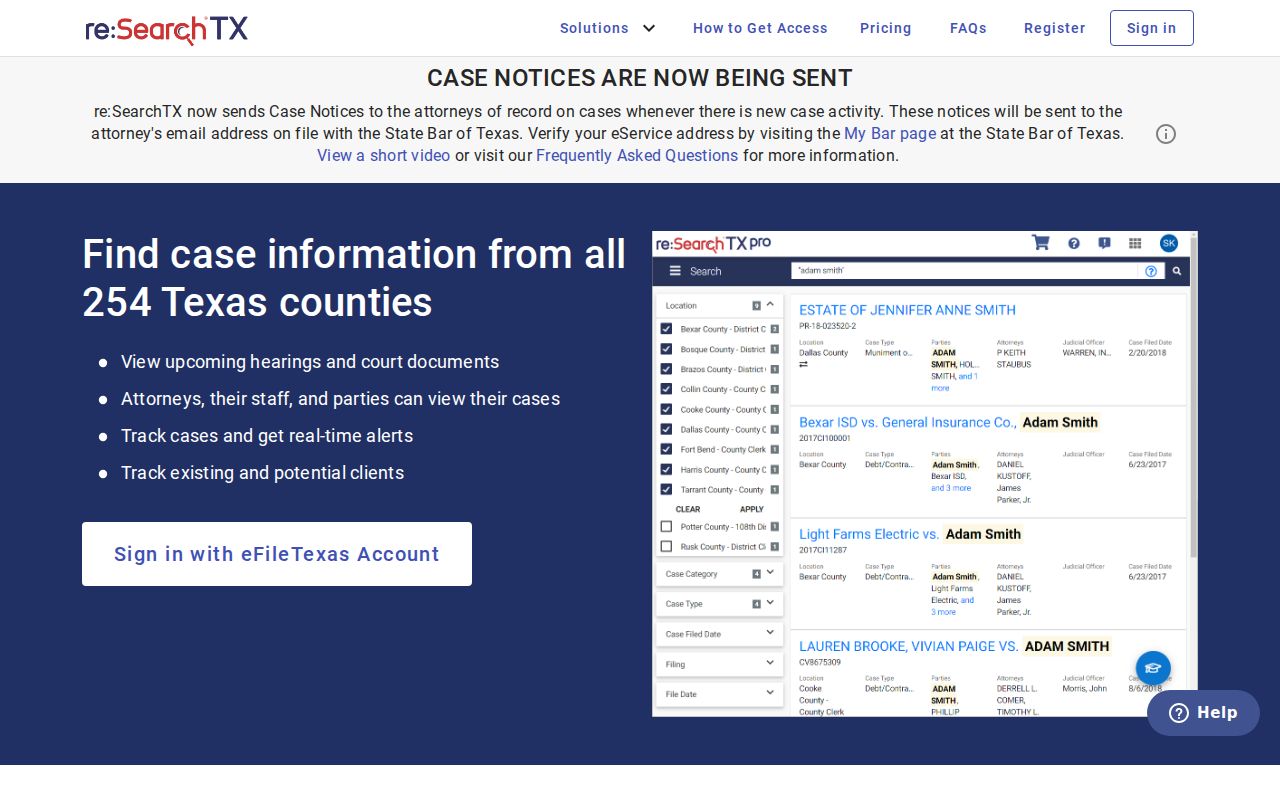
Treat the Cases and Hearings views as leads only. The clerk keeps the original Lampasas County record. The clerk can confirm what a document says and where the case stands now. That step closes the gap between a summary and the real court file.
Not everything shows up. Account level and document security filter the results. A sealed case, a confidential family paper, a juvenile matter, or an old paper file may simply be missing. When a statewide search comes back thin, the better move is a targeted clerk request instead of assuming the docket has no more entries. The companion Lampasas County docket search walks through the lookup fields worth gathering before you ask for copies.
Lampasas County Records Landmark
The restored courthouse orients any visitor. Yet not every Lampasas County court record lives inside that landmark. Per the Texas Historical Commission, it is an 1884 Second Empire building. W. C. Dodson designed it. Restoration work covered the foundation, roof, systems, historic windows, and accessibility before the 2004 rededication. The native limestone and central clock tower make it hard to miss.
Routing is more precise today. County Judge and constitutional County Court administration use the courthouse address at 501 E. 4th Street. The District Clerk and County Clerk sit elsewhere. They occupy different suites of the annex complex on nearby South Pecan. Call the clerk who holds the file before you go. A landmark address never proves the case file you need is stored there.
Copy Fees and Certification
A plain copy just reproduces what the record shows. A certified copy goes further. The clerk adds a certificate and seal. It can stand in as an authenticated court paper. Under the Texas District Clerk Manual, the statutory schedule effective for copies took effect January 1, 2024. Check the total, payment form, and delivery cost with Lampasas County before you order.
| Item | Published Amount |
|---|---|
| Noncertified paper copy | $1 per page or part |
| Certification and seal | $5 plus applicable page charges |
| Electronic copy of an electronic record | $1 per page through 10 pages, then $0.10 per page over 10 |
| Lampasas County public name search | No county-specific fee located; the County Clerk says it does not search for the public |
QuickLink charges $1 per page plus a $0.25 processing charge on purchased land or official-record pages. That is not the District Clerk's court-copy fee. JP and municipal charges need confirmation from the court holding the citation or civil file.
Mailing Lampasas County Record Requests
A strong written request names the requester, the court, the cause number, and the case style if known. Add the document title or filing date, copy type, number of copies, and delivery method. Ask for a fee quote before paying. The District Clerk takes routing questions by email at districtclerk@co.lampasas.tx.us. Fax works too, at 512-556-9463. General county open-records mail goes to Lampasas County Open Records Request, 501 E. 4th Street, Lampasas, TX 76550. You can also email openrecordsrequest@co.lampasas.tx.us.
Court-file requests still belong with the responsible clerk. The District Clerk's published counter is 409 South Pecan Street, Suite 204, Lampasas, TX 76550, reachable at 512-556-8271. Hours run 8:00 a.m. to 5:00 p.m. The counter closes from noon to 1:00 p.m. Call ahead when the record is old, large, or possibly confidential.
Lampasas County District Clerk
409 South Pecan Street, Suite 204
Lampasas, TX 76550
512-556-8271
Access Rules for Court Records
Access turns on the kind of record. Under the Texas judiciary open-records policy, judicial records fall under Rule 12 and other law. Texas Government Code section 552.0035 puts information collected, assembled, or maintained by or for the judiciary under Supreme Court rules. Other applicable law applies as well. A routine Texas Public Information Act request cannot shortcut those court-file restrictions.
Filed case records carry their own limits. Texas Rule of Civil Procedure 76a governs sealing in civil matters. Some filings get extra protection. Juvenile files, protected personal data, and papers sealed by court order may be withheld or redacted. Redaction strips protected details from the public copy you receive. Ask the clerk whether a public version exists. Do not chase restricted data.
Key Texas access rules:
Government Code Chapter 552 distinguishes judiciary records from routine agency records.
Rule of Judicial Administration 12 supplies the judiciary’s route for judicial-record requests.
Texas Rule of Civil Procedure 76a sets the process for sealing civil court records.
A public docket entry can still point to a document that is not open online. Confirm access and current status with the Lampasas County court or clerk that issued it.